

Extreme cold weather can be worrisome for horseowners.
 Would you have been worried about your horses last month if they lived outside 24/7 with no manmade shelter? This is the second winter that our horses have lived on a rolling pasture at the Dundas Valley Conservation Authority. Their only shelter is in the valleys or forest. So yes, we worried, and we kept extra close watch on them in January to ensure they had the resources they needed to survive the cold.
Our horses are on a forage-first diet and always have access to hay in their OptiMizer slow feeders. They forage what they need, when they need it. Digesting hay fibre in their hindgut is their main source of adjustable body heat. I like to think of hay as the fuel that keeps the “furnace” going in the horses’ body. In bitter, cold weather they dial up the amount of hay they eat to keep themselves warm.
We test our hay each Fall to determine the best recipe for our herd. We look carefully at:
1. Calories = DE (Digestible Energy)
With a number of easy keepers in our herd, we prefer getting hay that is low in calories to help with weight management.
2. Protein
All of the horses in our herd are aged 20 years or older. Older horses typically need higher crude protein to combat age-related muscle loss.
3. Sugar (NSC, ESC)
There is a metabolic horse in the herd with a history of laminitis. We want to feed low sugar hay.
4. Fibre (Lignin, ADF, NDF)
This is the fuel for the furnace. They need appropriate levels of fibre types to turn up the heat in the extreme cold.
Last year, we had a hard time getting a single source of hay that met all our requirements. Our first-cut grass hay was very palatable, but it was low in protein and high in sugar. So, we supplemented this with some alfalfa hay to increase protein and calories, decrease the sugar and balance the fibre.
We used compact bales and fed 4 grass bales and 1 alfalfa bale per OptiMizer. This was about 250 pounds of hay per feeder, resulting in a mix of 80% grass and 20% alfalfa hay. The table below shows the test results for this hay recipe.The horses always had hay available and the slow feed netting on their feeders (sized 1.6” and 1.25”) optimized their intake and prevented waste. Also, all the horses were on a ration balancer and the oldest horses received an amino acid supplement.
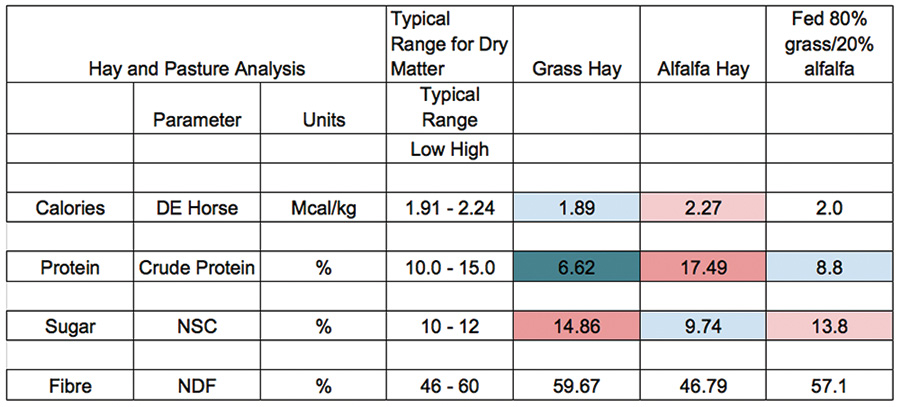
● Shading indicates above (red) or below (blue) typical range recommendations for each parameter.
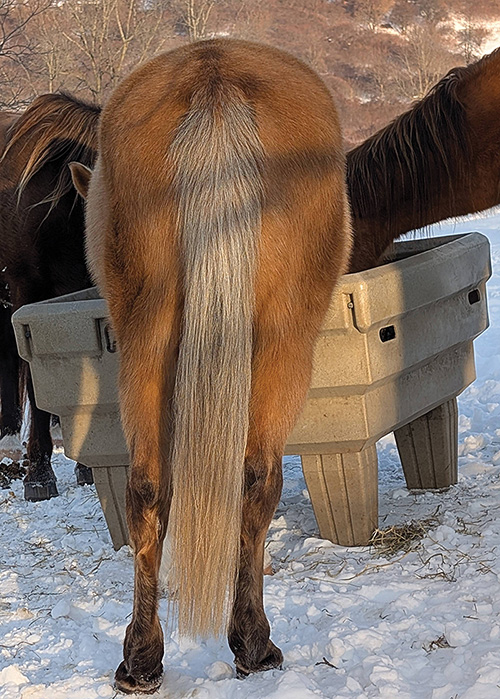
Several times last month, I wondered if I should blanket my 27 year old Kentucky Mountain Horse, the palomino in the photo. He has such a beautiful, thick winter coat that naturally responds to the weather. It really fluffs up in the extreme cold to maximize the amount of trapped air for insulation. And with all the fresh snow, his coat has stayed clean, with virtually no grooming needed. We kept an eye on his condition and behaviours to assess his comfort in the cold. He has been fine and so far this winter, has not been blanketed. (I also periodically take photos like this and record his body condition score using an awesome tool from Equine Guelph. This helps me note gradual changes over time.)
Finally, and probably most importantly, we ensured that the horses always had easy access to liquid water. They have a water trough with a floating heater in a spot in their pasture that has good footing. My palomino wears a Tractive GPS on his halter and we recorded that he visited the water trough area 4 - 6 times every 24 hours during the cold weather.
Extreme cold weather can be worrisome for horseowners. Despite the extreme cold in January 2026, our horses survived outside 24/7 with no manmade shelter or blankets. In fact, with optimized hay and water, not only did they survive, they thrived!