

What Happens When Your Coach Isn’t There?
You’re at the show, your horse felt great yesterday. Today, something is off.
Maybe they’re lazy, maybe they’re fresh, maybe the warm-up pen is chaos, your class is running earlier than expected, or the plan you had in your head clearly isn’t working.
And your coach isn’t there.
Now what?
One of the things Jen is very keen on as a coach is creating riders who can think for themselves. She doesn’t want us to become reliant on her standing at the side of the arena telling us what to do.
Of course, that would sometimes be considerably easier, but that keeps us in a need-state.
Instead, the lessons at home are also about learning why we’re doing something. What are we trying to achieve? What does it feel like when it’s right? What do I do when I feel something going wrong?
Because at some point, you have to be able to take what you’ve learned at home and apply it when nobody is standing there giving you instructions, and shows are where that really gets tested.
Your horse doesn’t know that today would be a particularly convenient day to behave exactly as they did during your lesson on Wednesday.
Things happen.
So you have to become your own problem solver.
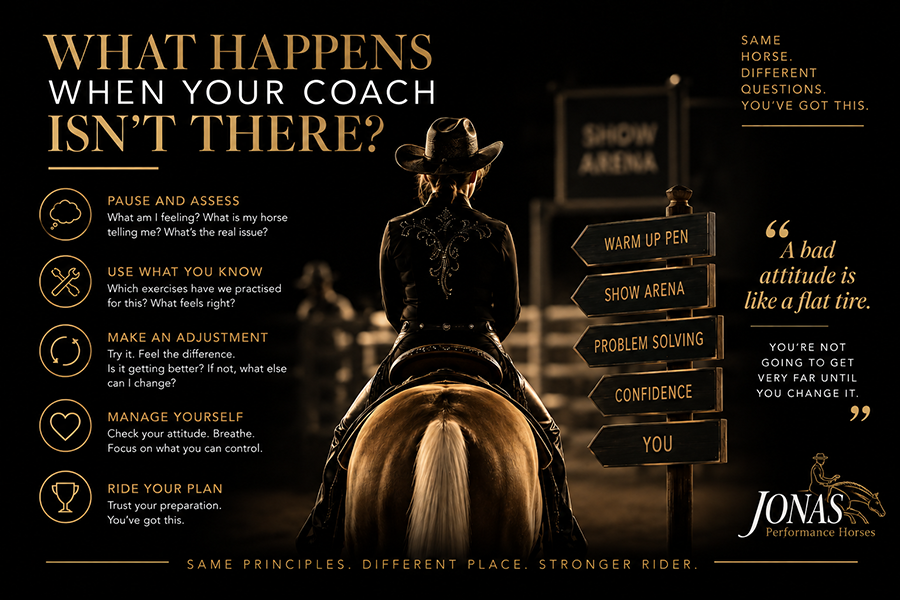
What am I actually feeling? What’s the problem I’m trying to fix? What exercises have we used at home for this? Is what I’m doing making it better? If it isn’t, what else do I know?
The show pen isn’t just where you discover whether you can follow instructions, it’s where you discover whether you’ve learned how to think.
But there’s another part of managing yourself at a show that has very little to do with your ability to ride.
Your attitude.
Shows rarely provide perfect circumstances. Classes run late, or early. The warm-up pen is packed, you couldn’t get a paid warm-up. Your horse decides that the flappy banner they walked past yesterday now hides a horse-eating monster. Someone annoys you, (happens!) and something goes wrong.
You can spend the next three hours being thoroughly pissed off about it; it won’t change any of it.
At JPH we love this analogy: a bad attitude is like a flat tire. You’re not going to get very far until you change it.
Having a good attitude doesn’t mean pretending everything is marvellous when it clearly isn’t, it means recognising the situation you’re in and asking:
Okay. What can I do from here?
Because when your coach isn’t there, you actually have two things to manage.
1. Your horse
2. Yourself
Most of the time, the reality is, it’s yourself needs sorting out first.
Frustration, nerves or annoyance can change the decisions we make. We stop thinking about what the horse needs and start knee-jerk reacting to what we think should be happening.
Being able to stop, assess what’s going on, draw on what you’ve learned and make an adjustment is a skill.
So is recognising when your own attitude needs an adjustment.
Perhaps one measure of a great coach isn’t how well their students ride when the coach is standing beside them, it’s how well they ride when they’re not there.
Because eventually, the person who spots the problem, thinks it through and figures out what to do next needs to be you.
And if necessary, change the flat tire first!
-----------------
'From the Trainer's Eye articles written by Jen Jonas of Jonas Performance Horses and one of her students, Sharon Jones of Be A Better You Inc. Both Jen and Sharon are believers in continuous learning - if you're not learning you are not growing'