


Horses are not like tables.
There’s a big difference between knowing when to push your horse and knowing when it’s time to stop.
It’s a delicate balance that a lot of non-pros get wrong, and even experienced trainers can fall into the trap of pushing for perfection when perhaps they should have called it a day.
The challenge, of course, is that horses don’t directly tell us, ‘Oy, you up top, pack it in! I don’t know what you want me to do. You need to ask me or show me a different way!’
Is the horse being belligerent, confused, tired, uncomfortable, or perhaps Mr Ed just isn’t feeling himself today?
Horses are not like tables.
You measure a table one day and it’s 10' x 10'. You measure it tomorrow, next week or next year and its dimensions remain the same.
Horses and humans are not like tables. Some days horse and rider are in perfect harmony. The rider asks, the horse understands and responds, and everything feels effortless. Other days, something that was easy yesterday suddenly becomes a struggle.
Horses learn through the release of pressure, but knowing exactly when to release, how much to ask and when to stop takes experience.
Sharon: I had a horse, Bentley, whom I bought as a coming two-year-old and started under Jen’s guidance. By the time I sold her at six, she was an awesome horse. She loved Ranch and trail riding but hated reining, unfortunately, which was what she’d been trained for!
Bentley wasn't the sort of horse to give in easily. We were both strong-willed and, occasionally, rather competitive with each other.
One day, during a lesson at Jen’s, we spent about 20 minutes trying to teach Bentley something she simply wasn't grasping. Whether she was coming into heat or just wasn't in the mood, her mind wasn't on the job.
Jen recognised that continuing wasn't achieving anything. Instead, we asked Bentley to do something easy that she knew well, rewarded her and finished.
Had I been riding alone, there's a good chance I'd have kept trying, determined to get the result I wanted. Jen helped me understand that you can't always 'win', and sometimes insisting on one more attempt achieves precisely the opposite.
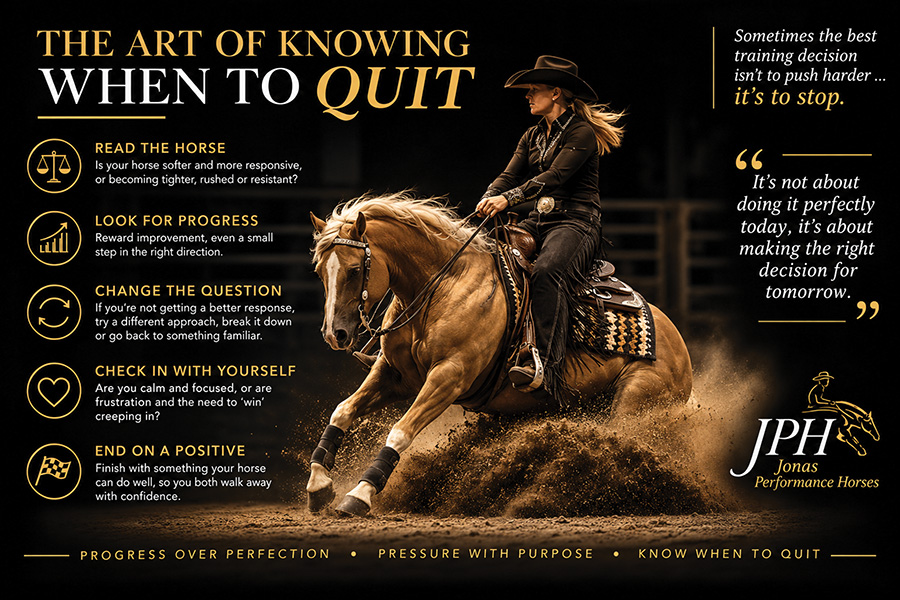
Jen: One of the hardest things to teach riders is recognising when they've made enough progress for one session.
Trainers such as Andrea Fappani, Shawn Flarida and Casey Deary emphasise rewarding improvement, adapting to the individual horse and recognising when resistance might indicate discomfort rather than disobedience.
If you're working on a spin and your horse gives you three really good steps, why insist on another full rotation? Those three steps may be the breakthrough you've been looking for.
That doesn't mean avoiding repetition. Horses need practice, and sometimes we need to work through resistance. But there's a difference between productive repetition and drilling.
Watch what happens between attempts. Is your horse becoming softer, more relaxed and responsive, or increasingly tense, rushed or resistant? Is each attempt producing an improvement, however small, or are you simply repeating the same mistake?
Sometimes changing the exercise, breaking it into smaller pieces or returning to something familiar produces better results than increasing pressure.
And don't forget the rider's state of mind. Frustration has a habit of turning training into a battle of wills, and horses rarely benefit from our determination to prove a point.
Knowing when to quit doesn't necessarily mean ending the ride. Sometimes it means changing the question, rewarding a small improvement or recognising that today's horse isn't quite yesterday's horse.
The skill is knowing the difference.
-----------------
'From the Trainer's Eye articles written by Jen Jonas of Jonas Performance Horses and one of her students, Sharon Jones of Be A Better You Inc. Both Jen and Sharon are believers in continuous learning - if you're not learning you are not growing'