

"Ride that horse straight, like a coffee table."
Sharon: Many, many years ago, when I switched from Barrel Racing to Reining, I thought I could do it myself.
Ha!
Talk about getting humbled… frequently.
It took me a while to find the right coach. Just like any relationship, it matters how you feel about your coach. You need someone whose style clicks with you, and equally, a coach who genuinely wants you to succeed.
From our very first lesson, I loved Jen's way of communicating.
"Ride that horse straight, like a coffee table."
Before I had time to wonder what on earth she meant, she added, "Not like those wiggly 1980s coffee tables… straight!"
I nearly fell off laughing.
The image landed exactly where it was supposed to, and I've never forgotten it and I haven't looked back since.
Being fascinated by psychology, I started wondering why having a good coach makes such a difference. It turns out there are some very good reasons.
One of the biggest is that we all have blind spots. By definition, a blind spot is something we cannot detect ourselves.
When you're riding, you're concentrating on where you're going, what your horse is doing, your own position, the next manoeuvre and everything you're trying to remember.
Meanwhile, your coach is noticing your shoulders creeping forward, tension in your hands, your horse drifting off the line, your timing being a fraction late, or perhaps your confidence beginning to disappear.
You simply cannot watch yourself while you're performing.
Research into expert performance by psychologist Anders Ericsson found that improvement doesn't come from repetition alone. It comes from immediate feedback, correcting errors and continually working just beyond your current ability.
Without feedback, we often become really good at repeating the same mistakes.
You don't practise until you get it right, you practise until you stop getting it wrong.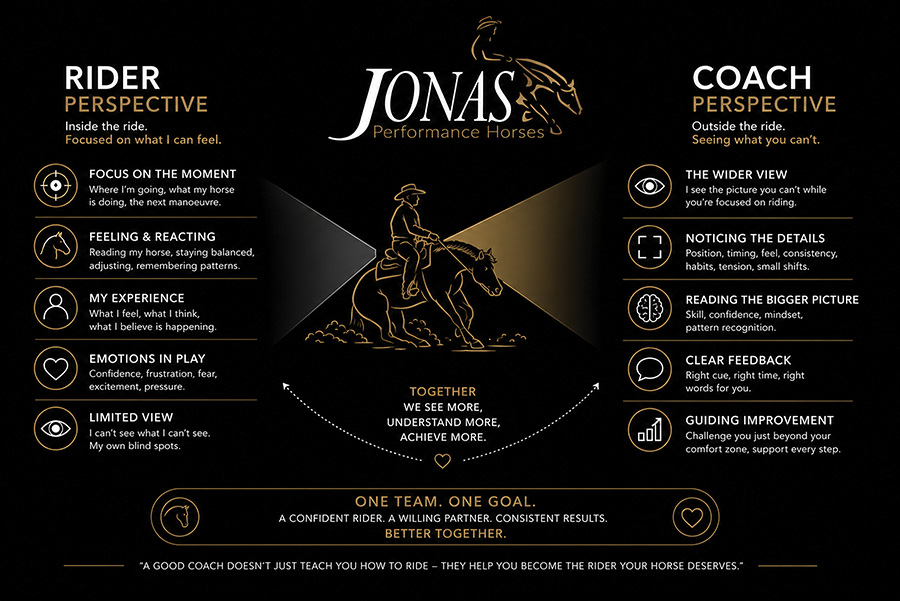 Jen: From a coach's perspective, I'm not there to prove how much I know. I'm there to notice what the rider can't see.
Sometimes that's technical, sometimes it's emotional.
Most of the time, it's both!
One rider might need a different explanation, another might need more confidence. Someone else might simply need to breathe.
The trick isn't giving everyone the same instruction, it's recognising whether the problem is a lack of skill, a lack of confidence, fear, confusion, poor timing or simply information overload.
The horse is responding to whatever the rider is communicating in that moment. My job is to help the rider understand what both they and their horse are telling me.
The best coaching is never just about the horse, it's about the partnership.
Sharon: Perhaps the biggest lesson I've learned is that asking for coaching isn't a sign of weakness, it's a sign that you're serious about improving.
Every Olympic athlete has a coach, not because they're incapable; because they understand that another pair of experienced eyes can see what they cannot.
Whether you're aiming for the Olympics, chasing your next buckle, or simply wanting a better ride on your favourite horse at home, the principle is exactly the same.
Your horse doesn't know what your goals are, they simply respond to what you ask of them.
A good coach helps make sure you're asking in the clearest, kindest and most effective way possible.
And that's why, even after all these years, I still happily hear Jen say, "Again..."
-----------------
'From the Trainer's Eye articles written by Jen Jonas of Jonas Performance Horses and one of her students, Sharon Jones of Be A Better You Inc. Both Jen and Sharon are believers in continuous learning - if you're not learning you are not growing'