



Beeler-Marfisi’s award-winning teaching philosophy is based on helping people understand big concepts first and then adding the details later.
Guelph, ON - Sept 9, 2026 - "The thing that I see most commonly is people trying to learn all the details before having built their scaffold of basic understanding," says Ontario Veterinary College researcher and associate professor, Dr. Janet Beeler-Marfisi.
Horse owners do it all the time. Diving into articles about nutrition, respiratory disease, metabolic disorders, or the latest research findings and quickly become overwhelmed by unfamiliar terminology and scientific detail. Determined to learn more, we delve deeper into the details before fully understanding the bigger picture.
According to Beeler-Marfisi, that approach can make learning harder than it needs to be. She compares it to moving desks and computers into an office building that hasn't been built yet. Without a solid framework, all those details have nowhere meaningful to go.
Beeler-Marfisi’s award-winning teaching philosophy is based on helping people understand big concepts first and then adding the details later.
It's an approach that has earned her three teaching awards this year from the Ontario Veterinary College. The same learning strategies can help horse owners make sense of increasingly complex health information and become more confident in the decisions they make for their horses. “You don’t have to have a PhD-level understanding in order to do a good job of looking after your horse," shares Beeler-Marfisi.
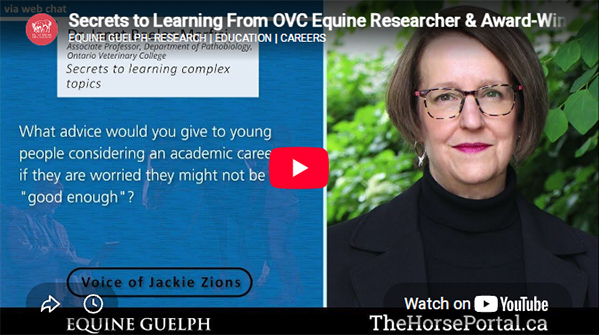
Dr. Janet Beeler-Marfisi provides tips for leaning complex topics
Start With the Big Picture
One effective learning tool Beeler-Marfisi recommends is building a mental framework before attempting to absorb details. Rather than memorizing isolated facts, learners should first understand the core concept and how related ideas connect to it.
That might mean understanding how the respiratory system works before trying to interpret research on air pollutants, inflammation, or equine asthma. Once the foundation is in place, the finer details become easier to understand and remember.
Another strategy is mind mapping. By placing a central concept in the middle of a page and drawing connections to related topics, learners create a visual framework that shows how information fits together.
"For example, we have a central concept like anemia, and you put that in the middle, and then you say, there's these different kinds of anemia, and you draw little lines out from that central idea, and then you add more detail into it," Beeler-Marfisi explains. Students often find the technique useful because it creates the "scaffolding" needed before adding more complex information and seeing those relationships can make a complicated topic far less intimidating.
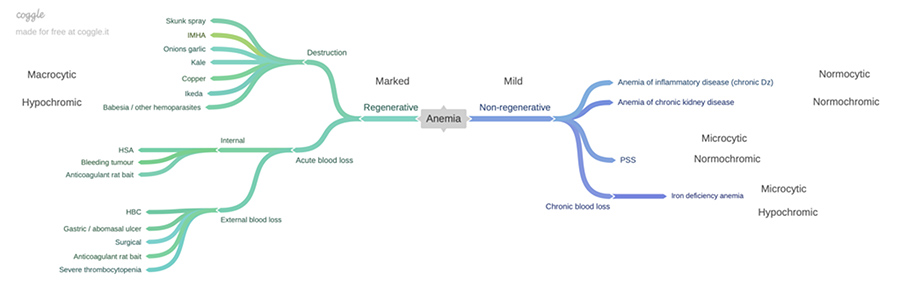 Anemia Mind Map by J Beeler-Marfisi
Make Learning Visual and Memorable
Beeler-Marfisi is known for incorporating creative teaching techniques into her classrooms. Visual cues, drawings, and hands-on activities help students engage with concepts in multiple ways.
She also teaches memory techniques such as the "Method of Loci," often called a memory palace. The method involves placing memorable images within a familiar location and mentally revisiting that space to recall information later. Sometimes the more comical or outrageous the better!
Beeler-Marfisi recounted a presentation she gave at an equine expo where she brought in a vacuum cleaner to demonstrate the lungs hoovering up dust! “When you put your finger down your tack box, it's rare that it doesn't come away with some dust on it and that is what we and the horses are breathing in… So that's how I try and make it as simple as possible. People don't need to know that PM 2.5 crosses the lung barrier and then can go to the brain and does this, that and the other bad thing. They just need to know that it gets in the lungs, and this can contribute to equine asthma.”
The approach demonstrates an important principle: people remember information more easily when it is connected to vivid stories, images, or experiences.
Simplifying Science Without Losing Accuracy
One reason Beeler-Marfisi has become a valued contributor to educational resources at Equine Guelph is her ability to translate scientific concepts into practical knowledge.
“Equine Guelph’s director Gayle Ecker told me this story. According to Einstein, if you couldn't explain it to an eight-year-old, you didn't really understand it. So I think many of us move throughout our day in our various ways of expertise, and we talk in a lot of jargon.”
Rather than overwhelming audiences with technical jargon, Beeler-Marfisi focuses on helping them understand the key message. When discussing respiratory health, she often uses relatable examples and visual demonstrations to make the science easier to grasp, like the lungs are a lot like the filter in your vacuum cleaner. For horse owners, that ability to separate essential takeaways from technical detail is particularly valuable. Research findings are important, but understanding how those findings affect daily horse care is what ultimately leads to better decisions.
Why Research Literacy Matters
As a researcher, Beeler-Marfisi believes horse owners benefit from understanding the science behind management decisions. One example she highlights is the growing evidence surrounding air quality and equine health. Horses exercised during periods of poor air quality may experience respiratory effects that persist well beyond the pollution event itself.
For owners, the lesson is not to become an expert in pulmonary physiology. Instead, it is to understand enough of the science to make informed choices that support the horse's long-term health and well-being. “I know it's hard to not exercise one's horses because they obviously need to move but I think avoiding exercising on those high pollution days will mean that you've got more health and well-being of your horse a week to three weeks after that air pollution event,” emphasizes Beeler-Marfisi.
She then cited Equine Guelph’s evidence-based, welfare-based courses on Equine Anatomy and Physiology, and Equine Respiratory Health as excellent ways to build a scaffold of basic understanding.
Learning Never Stops
Whether she is teaching veterinary students, mentoring future professionals, or helping horse owners understand research, Beeler-Marfisi's message remains consistent: learning works best when people feel supported, curious, and confident enough to ask questions.
The next time you find yourself overwhelmed by a complicated article or unfamiliar scientific term, remember the advice: Build the framework first. Focus on the big picture. Then add the details.
You may not need a PhD to care for your horse, but according to this OVC celebrated educator, learning more about the science behind horse health can help every owner make better decisions.
About Equine Guelph:
Equine Guelph is the horse owners' and care givers' Centre at the University of Guelph in Canada. It is a unique partnership dedicated to the health and well-being of horses, supported and overseen by equine industry groups. Equine Guelph is the epicentre for academia, industry and government - for the good of the equine industry as a whole. For further information, visit www.equineguelph.ca.
Story by: Jackie Bellamy-Zions, Equine Guelph Communicatons
Web Link(s):
Story web link: https://thehorseportal.ca/2026/09/secrets-to-learning-from-an-ovc-equine-researcher-award-winning-professor/
Other links:
Video interview: https://www.youtube.com/watch?v=5kM3mQhV3jo
https://www.uoguelph.ca/ovc/news/2026/07/dr-janet-beeler-marfisi-celebrated-three-student-centered-awards-ovc-convocation
https://thehorseportal.ca/2026/07/smoke-inhalation-and-horses/
Equine Anatomy and Physiology: https://courses.scs.uoguelph.ca/search/publicCourseSearchDetails.do?method=load&courseId=55631345
Racehorse Respiratory Health: https://thehorseportal.ca/course/racehorse-respiratory-health-winter-27/
Source: Equine Guelph