



What Every Horse Owner Should Know
Guelph, ON Mar 25, 2026 - As summer arrives, veterinarians and horse owners across Canada grow increasingly concerned about Potomac Horse Fever (PHF). Once rare, the disease is appearing more often in regions north of the U.S. Potomac is now considered endemic in Ontario, Quebec, Nova Scotia, Manitoba, Alberta, and British Columbia.
What Is Potomac Horse Fever?
Potomac Horse Fever (PHF), also called equine neorickettsiosis or equine monocytic ehrlichiosis, is a serious intestinal disease affecting horses during warmer months. First recognized in 1979 near the Potomac River in Maryland, PHF has spread across North and South America and now is on the rise in parts of Canada. The disease is caused by Neorickettsia bacteria found inside parasitic flatworms that infect aquatic insects such as mayflies, caddisflies, and dragonflies. Horses become infected when they ingest these insects while grazing or drinking from contaminated water.
Why Are Cases Increasing?
Dr. Luis Arroyo from the Ontario Veterinary College says, “Climate change and shifting insect populations may be contributing to the spread of Potomac Horse Fever into new regions, including parts of Ontario where it wasn’t previously seen. Increased awareness and better diagnostic tools are also helping identify more cases.”
 Symptoms: What to Watch For
Common signs include high fever, lethargy, loss of appetite, diarrhea/colitis, colic-like symptoms, laminitis, and abortion in pregnant mares. PHF can lead to laminitis, and studies show that about 25–40% of affected horses develop laminitis. PHF associated laminitis frequently involves multiple limbs and can be severe, so early treatment is especially important. Arroyo shares an encouraging statistic from a recently published review paper (2026): “For horses who suffer from PHF‑associated colitis, there is a 73% survival rate when treatment is started promptly.
Diagnosis and Treatment
Diagnosis typically uses blood and fecal testing including PCR. There are different strains and species of PHF>. Neorickettsia findlayensis is a newer species, now confirmed in Ontario, Quebec, Alberta, and BC. Species-specific PCR tests can tell whether a horse has N. risticii or N. findlayensis.
Treatment usually includes oxytetracycline and supportive care such as IV fluids.
Prevention: Protecting Your Horses
While no preventative method is perfect, horse owners can take several steps to reduce risk. There are many different strains and two known species of the Potomac Horse Fever bacteria. Talk to your veterinarian about vaccination. While it doesn’t prevent all cases, it may help lessen the severity of illness and is still a useful part of an overall risk‑reduction plan.
Consult your veterinarian about vaccination and inquire about specific disease risks in your area and areas you plan on travelling to with your horse. AAEP guidelines explain the seasonality of Potomac Horse Fever and recommend administering vaccines a month ahead of expected cases. For primary vaccinations, two doses are given 3 – 4 weeks apart. Discuss frequency of revaccination with your veterinarian. PHF has a strong seasonal pattern (late spring through fall, peaking in summer).
Reduce insect exposure by limiting standing water, turning barn lights off at night, and cleaning water sources. Infection can occur from contaminated water containing stages of the parasite/trematode that carry the bacteria.
Maintain pasture and stable hygiene to limit contact with aquatic insects. Horses within 8 kilometres of waterways have substantially higher risk because of insect emergence.
Additional Resources:
Sign up for Equine Guelph E-news to receive timely health alerts, including updates reposted from the Equine Disease Communication Center (EDCC). These alerts help horse owners stay informed about emerging disease threats. In February 2025, Equine Guelph partnered with EDCC to relaunch the Biosecurity Risk Calculator. Check out this practical resource that helps horse owners assess and reduce a wide range of disease risks on their farms.
Potomac Horse Fever Webinar with Drs. Ashley Whitehead (UCVM) and Luis Arroyo (OVC) hosted by Canadian Animal Health Surveillance System.
Arroyo LG, Moore A, Bedford S, Gomez DE, Teymournejad O, Xiong Q, Budachetri K, Bekebrede H, Rikihisa Y, Baird JD. Potomac horse fever in Ontario: Clinical, geographic, and diagnostic aspects. Can Vet J. 2021 Jun;62(6):622-628. PMID: 34219771; PMCID: PMC8118184.
Luis G. Arroyo, Alexandre S. Borges, John D. Baird, Brian D. Perry, Yasuko Rikihisa, Stephen E. Greiman, Equine neorickettsiosis: A global perspective of the natural habitat of the bacteria and clinical disease, Veterinary Microbiology, Volume 316, 2026,110963, ISSN 0378-1135, https://doi.org/10.1016/j.vetmic.2026.110963.
About Equine Guelph:
Equine Guelph is the horse owners' and care givers' Centre at the University of Guelph in Canada. It is a unique partnership dedicated to the health and well-being of horses, supported and overseen by equine industry groups. Equine Guelph is the epicentre for academia, industry and government - for the good of the equine industry as a whole. For further information, visit www.equineguelph.ca.
Story by: Jackie Bellamy-Zions, Equine Guelph
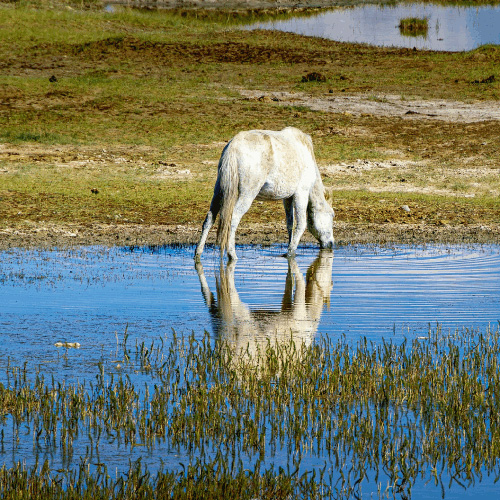
Photo Caption: Horses grazing or drinking near ponds and waterways may be exposed to aquatic insects that can transmit Potomac Horse Fever. Photo Credit: Stock image
Web Link(s):
Story weblink: https://thehorseportal.ca/2026/03/understanding-potomac-horse-fever-what-every-horse-owner-should-know/
Equine Guelph E-news sign up: https://equineguelph.ca/about/sign-up/
Biosecurity Risk Calculator: https://thehorseportal.com/biosecurity-risk-calculator-tool/
Potomac Horse Fever (PHF) Webinar https://www.youtube.com/watch?v=teVDOJxuZ50
Review papers:
Potomac horse fever in Ontario: Clinical, geographic, and diagnostic aspects: https://pmc.ncbi.nlm.nih.gov/articles/PMC8118184/
Equine neorickettsiosis: A global perspective of the natural habitat of the bacteria and clinical disease: https://www.sciencedirect.com/science/article/pii/S0378113526000945
Source: Equine Guelph